
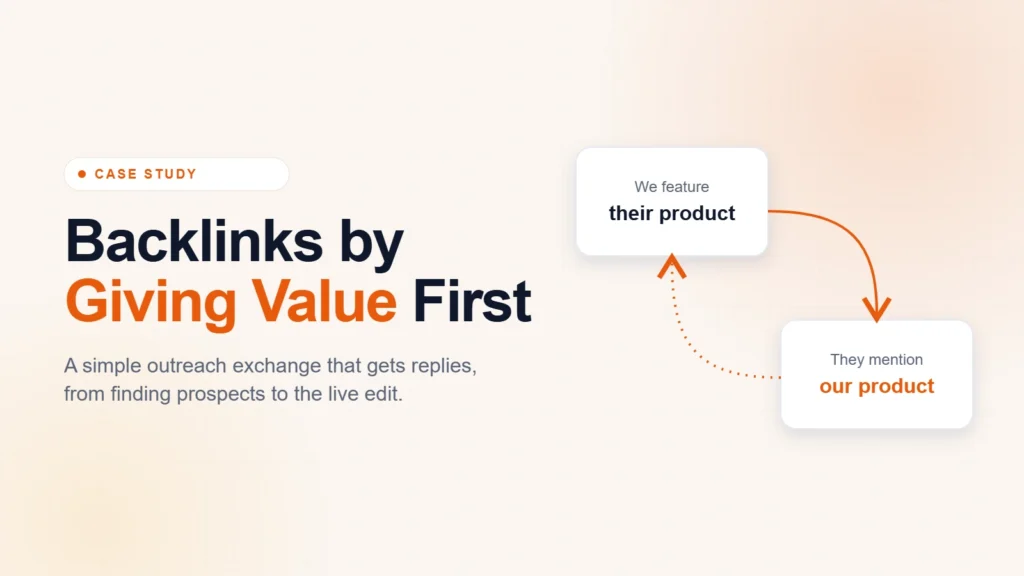
Most backlink outreach emails sound the same. “Hi, I loved your article. Can you link to my site?” Delete. Next.
I used to hate sending those emails, so I flipped the whole thing. Today I sent 12 outreach emails, and not one of them asked for a backlink first. Each one started with an offer to feature the other company’s product in a blog we are updating. The mention for our own product came second, as a simple exchange. That one change makes the whole conversation feel different, because the other person gets something before they are asked for anything.
In this case study, I will show you exactly how I do it, the tools I use to find opportunities fast, how I decide which companies are worth reaching out to, and how I get the placements live on my site without losing hours on manual work.
Key Takeaways
- Give first: offer to feature their product in your article before you ask for anything.
- Ask for a contextual mention: not a random link. A mention that sits naturally inside a relevant article.
- Use AI to find the spots: ChatGPT’s deep research finds the right placements in 2 to 3 minutes. The same work used to take me about an hour per prospect.
- Let Claude do the edits: once a collaboration is agreed, Claude updates the exact article for me in my logged-in browser.
What Is Value-First Backlink Outreach?
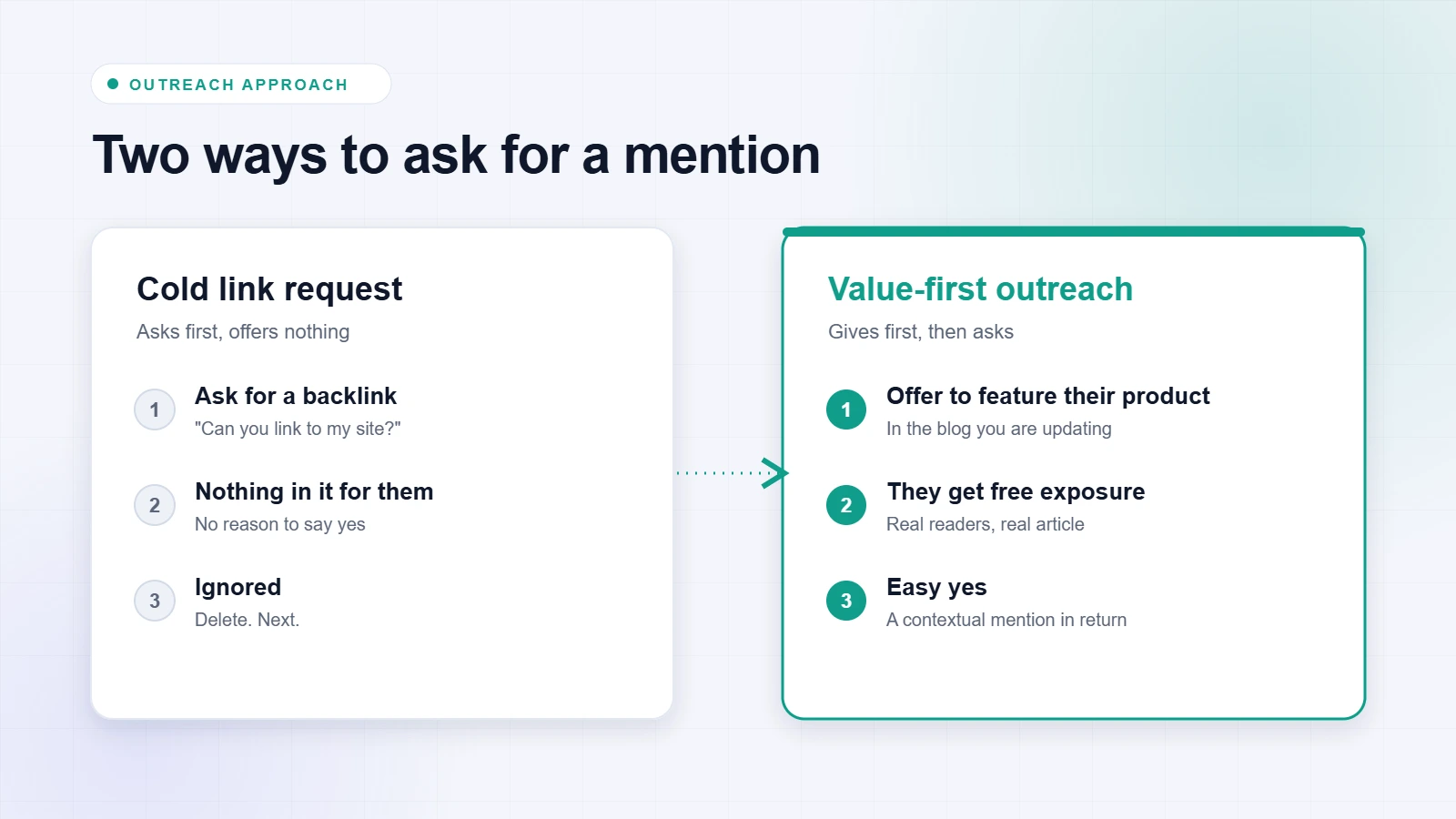
Value-first outreach means you offer something useful to the other person before you ask for a link. In my case, the offer is a feature. We are updating a blog post, and we would love to include their product in it.
That is free exposure for them, in an article that real readers will see and trust. Once that is on the table, I ask if they would be open to a contextual mention of our product in one of their relevant posts. I am not asking for a random link in a footer or a sidebar. I want a mention that sits naturally inside the content, where it actually helps their readers.
It is not a cold link request. It is a small collaboration where both sides get something useful, and that is exactly why people say yes.
Why This Works Better Than Asking for a Backlink
- It starts with a benefit to them: nobody has to be convinced to say yes to free coverage. You are bringing them readers and visibility, so the conversation starts on a positive note.
- The ask feels fair: an exchange of mentions is easy to understand and easy to agree to. There is no complicated deal and no pressure, just two relevant mentions.
- It is specific: you are not saying “link to us”. You are pointing to a real article and a real update. They can see exactly where they will appear, which builds trust fast.
- It feels human: the email reads like one blogger talking to another, not a template blast. People can tell when an email was written for them and when it was copied to hundreds of inboxes.
In my experience, the conversion rate with this approach is super high. The reason is simple. You are not just asking for a backlink, you are offering something first, so saying yes is an easy decision for them.
My Process, Step by Step
Step 1: Pick the Article You Are Updating
Everything starts with an article of mine that needs a refresh, like a roundup or a listicle. This is the offer, so it has to be real. I need a relevant article where their product genuinely fits, because if it feels forced to me, it will feel forced to them too. Updating an old article also gives me a natural reason to reach out, since I am improving something that already exists.
Step 2: Find Link Exchange Opportunities With ChatGPT
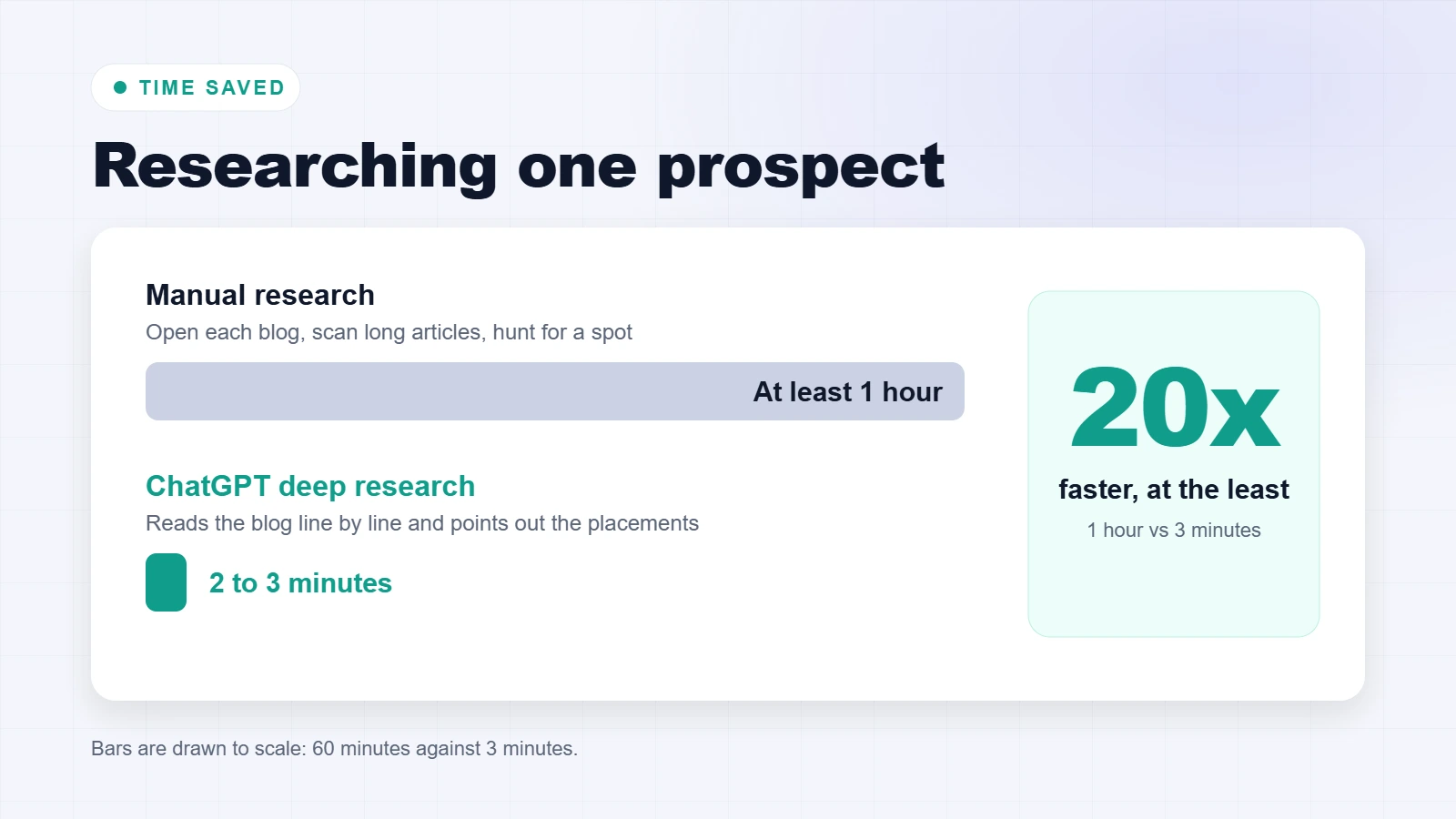
This is the part that used to eat my time. Researching each prospect and finding a real spot for our product took me at least an hour. I would open their blog, scan long articles and hunt for a place where our product fits. You can do it manually with search operators, but it adds up fast.
Now I use ChatGPT’s deep research in high mode, and the same job takes 2 to 3 minutes. It reads through even large websites and long articles, line by line, and points out the relevant placements. I get real opportunities, with the exact article and the exact context, instead of a list of random domains.
And no, you do not need a fancy prompt. A plain message does the job. Something like this:
Here are our products. I want you to read this site’s blog articles and find backlink opportunities for our products.
That is it. Paste in the products, point it at the site and let it read. The real value is not in a clever prompt. It is in the fact that it reads the actual articles and tells you exactly where your product could fit.
I still check the best ones myself before I send anything. The AI finds the spots. I decide which ones are worth an email. I open the article it points to, read the paragraphs around the spot and make sure the placement really makes sense. That quick check saves me from sending an email that does not fit.
Step 3: Choose Prospects Carefully
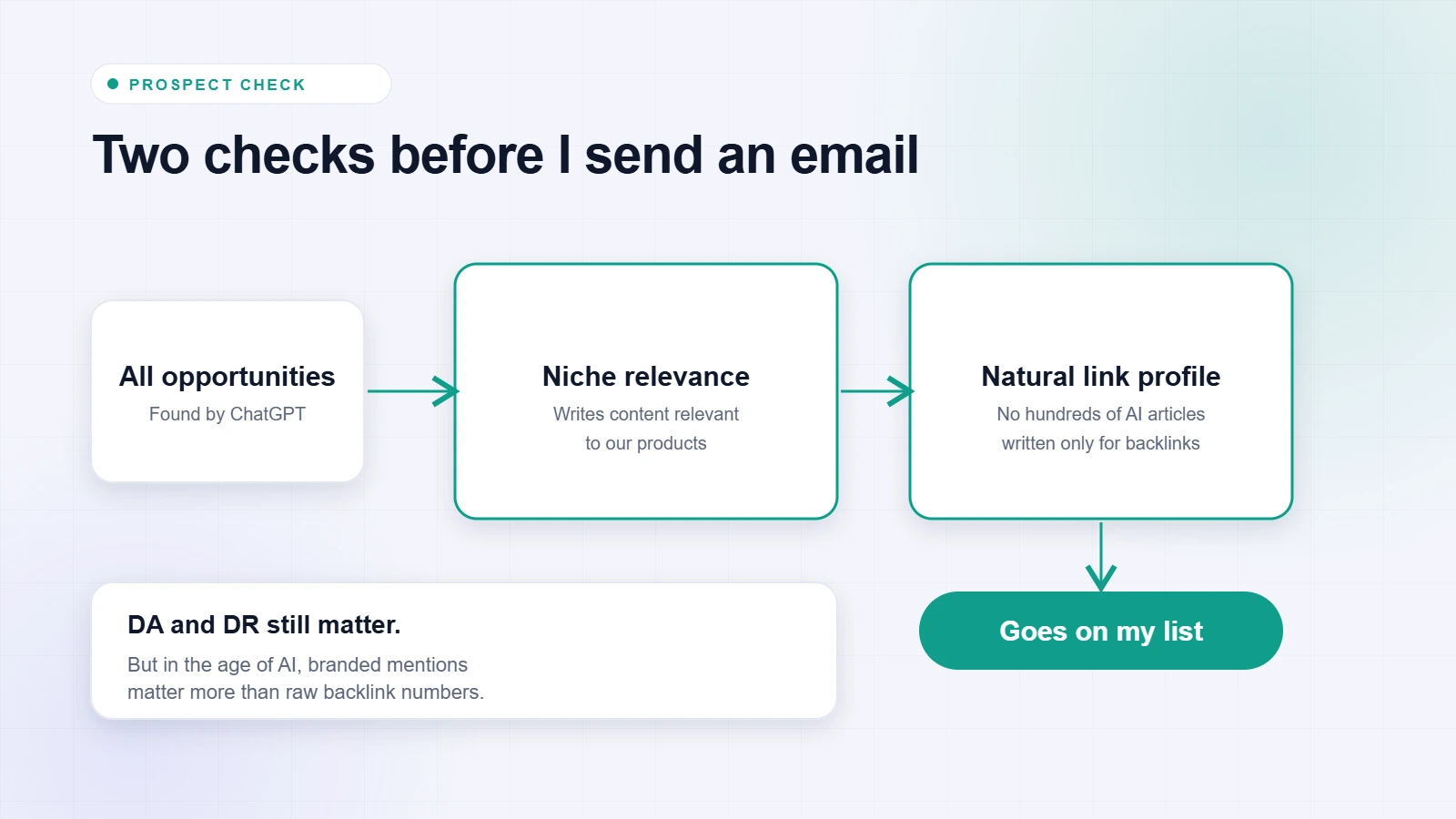
Not every opportunity deserves an email. DA and DR used to be the first thing I checked. They still matter, but in the age of AI, branded mentions matter more to me than raw backlink numbers.
So I look at two things first:
- Niche relevance: do they write content that is relevant to our products? If their readers would care about what we build, the mention makes sense.
- A natural link profile: I skip sites that publish hundreds of AI-generated articles just to earn backlinks. I want a real site with real content, not a link farm.
If a prospect passes both, it goes on my list. If it fails either one, I move on, even when the numbers look good. A mention on a site that is outside our niche, or one that looks built only for links, will not do much for us. In the age of AI search, being mentioned in the right place by the right kind of site counts for more than adding one more backlink to the pile.
Step 4: Send the Value-First Email
The email is short. I say we are updating a specific blog post, that we would love to feature their product, and that, in exchange, we would love to explore a contextual mention of our product in a relevant article of theirs. I do not write a long pitch. A short, clear email is easier to reply to, and it shows that I respect their time.
Here is a simple template you can adapt:
Hi [Name],
I came across [their product] while researching [topic]. We are currently updating our article on [topic], and I would love to feature [their product] in it.
If you are open to it, I would also love to explore a contextual mention of [our product] in your post on [their article], where it could be useful to your readers.
Happy to share the details of the feature first. Let me know what you think.
Thanks,
[Your name]
Keep it honest, keep it short and make sure both sides really fit. It also helps to name the exact article you are updating, so they know this is a real plan and not a mass message.
Step 5: Share the Collaboration Details
Once they say yes, they send the details I need, like the product description and the key features for the listicle entry. Now I have everything required to write their feature properly, in my own voice. Getting the details straight from them also means the feature is accurate, so I never have to guess what their product does.
Step 6: Let Claude Make the Changes
This is my favorite part. I give those details to Claude. It already has the context because I connected my Google Drive and Gmail. Then it uses my logged-in Chrome browser, goes straight to my site and updates the exact article.
No copy-pasting, no hunting for the right section, no switching between ten tabs. Claude finds the exact article and makes the change in the right place. I review it, and it is done. Since it already knows the context from my Drive and Gmail, I do not have to explain the whole collaboration again every single time.
A Few Things I Keep in Mind
- Relevance first: only reach out when the product genuinely belongs in the article, and the same goes for our mention in theirs.
- Do not turn it into a link scheme: Google’s spam policies warn against excessive link exchanges. A few relevant, editorial mentions are fine. Mass swapping is not.
- Quality over volume: twelve well-chosen emails beat two hundred blasts.
- Be honest about the exchange: I say clearly what we are offering and what we are asking for.
- Review before you publish: AI can find and edit, but I always check the final result.
Frequently Asked Questions
Do I Need a Big Blog to Try This?
No. You just need one article where a feature genuinely helps the other company. Even a small, useful roundup can work. What matters is that the article is relevant and genuinely useful to readers, not how big your blog is.
Is It Okay to Ask for a Link in Exchange for a Feature?
It is fine when the exchange is small, relevant and honest. Avoid doing it at scale or with sites that do not fit, because that is where it starts to look like a link scheme. Keep the number of exchanges low, make sure each mention is editorial and relevant, and never do it just for the sake of a link.
Can I Find Opportunities Without ChatGPT?
Yes. You can use Google search operators and check each blog by hand. It works, but for me it took at least an hour per prospect. With ChatGPT’s deep research, it takes 2 to 3 minutes.
Is It Safe to Let Claude Edit My Live Site?
It is, as long as you review the change. I give it the exact details and I check the result before I call it done. Claude already knows the context, but I still open the article afterward to make sure the changes are in the right place and nothing else was touched.
Summing Up
Good backlink outreach is not about pushing for a link. When you lead with value, the conversation feels natural, the replies come easier and every placement feels earned instead of requested.
Start small. Pick one article that genuinely needs an update, choose a few prospects that truly fit, and send honest emails. Let the tools handle the heavy lifting while you keep the final call. If you try this approach, I would love to hear how it goes in the comments.
1 comment